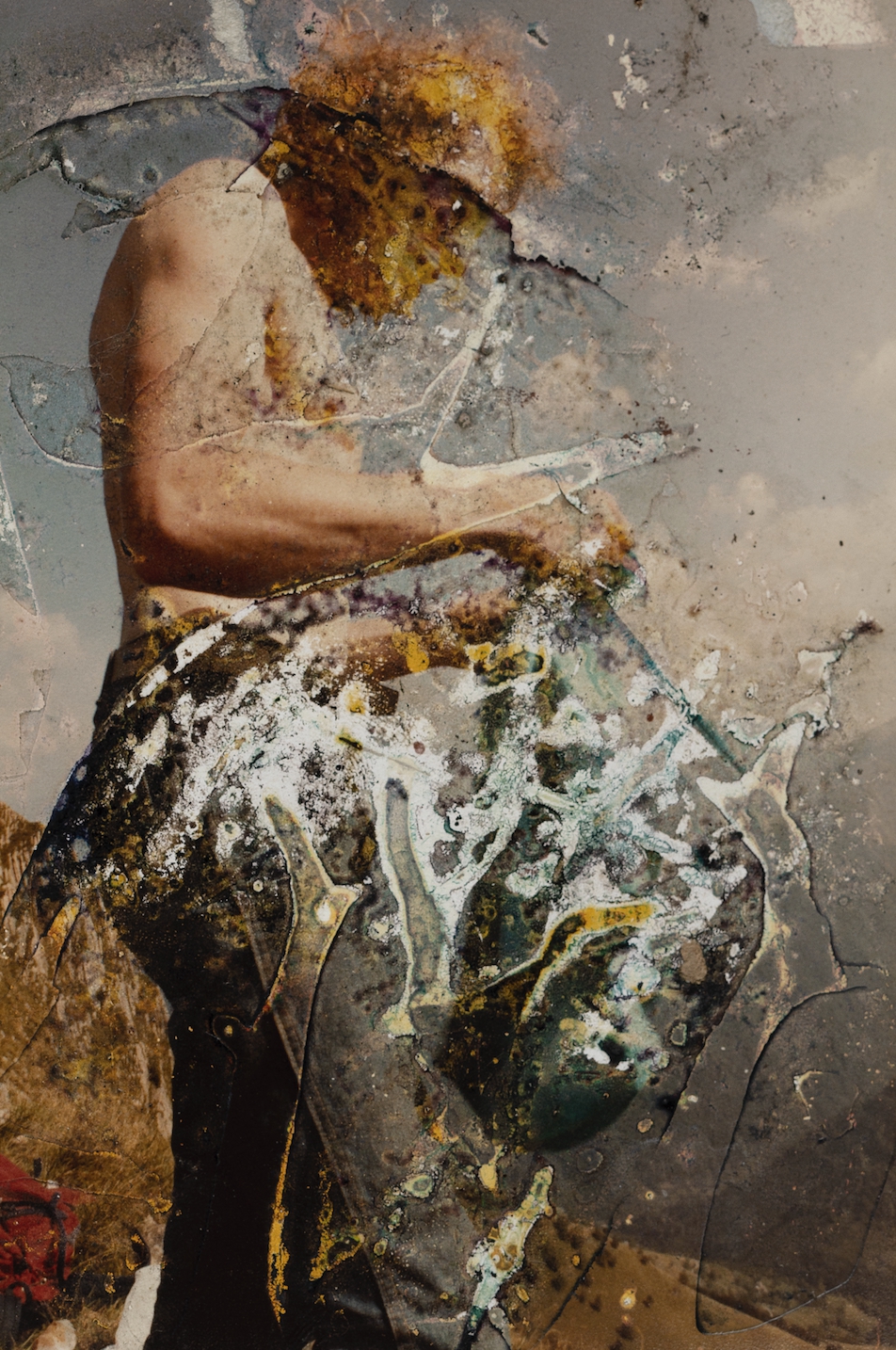
Entropia, 2022
Print on Hehnemuhle Museum Etching
1 × 150 × 100 cm | 3/8 × 59 1/16 × 39 3/8 in.
Edition 3/3 + 2 APs
Certificate provided by the artist
Bessancourt
Sold Contact us
The artwork pledge
Tags
About this artwork
"In relation to Ambrossio's work and as Chris Baldwick observed, in his introduction to a compilation of gothic narratives, a legitimate gothic work "must combine an unsettling sense of heritage in time with a claustrophobic sense of confinement in space, both dimensions reinforcing each other to produce an impression of maddening descent into disintegration. This "topology of horror," is a primary reaction to social, technological, and political change.” Cuahutemoc Medina
"Going through “The Witch Stage” means for me to abandon the natural place: raising children, pleasure and unconditional support for the professional and personal growth of the men around us, endure, endure, keep in balance and united to the family, not criticize religion, nor the acts of impunity, cowardice, and barbarism of the state, accept being trained, etc. I refer to myself and to all the wrong women, for whom necromancy represents the allegorical universe of a primarily feminine activity that has been obscured by a system that designates every woman with more power, vision, and ambition than society as an enemy of society.” Liza Ambrossio
During her year of residence at the "Casa de Velazquez" in Madrid, the artist decided to be a student of the anatomical dissection classes within the Faculty of Medicine of the Complutense University. She convinced the director of studies and began to attend twice a week. She was intrigued by the smell of the dead, and somehow thought of migrating it to "The witch stage," a project related to the culture of femicide more than as a social problem, a mental illness, relative to power.
One day the body of a woman murdered by her partner arrived. They checked her feet which were full of nail fungus. The victim carried analog photos in her backpack of people she had taken walks with, but were not especially important to her. Ambrossio's immediate reaction was to ask the director of studies to teach her how to migrate the fungus and infect her photos. This fungus meant "perpetual life" after death, and every few days the artist photographed the progress of the fungus on the tray, fed by proteins, water and in complete darkness. The results of this and other photos were different, but it revealed a trace of the imaginary memory of the dead. The man could be anyone at the moment of a mental breakdown, be it intimate partner or stranger; in the artist's imagination he represents power, madness, fragility, life, death, sleep, virility and desire.
More artworks by Liza Ambrossio
-
 Liza Ambrossio Auto destrucción, 2022
TAP LAB
Sold
-
 Liza Ambrossio Duplicidad, 2018
TAP LAB
Sold
-
 Liza Ambrossio El rasguño, 2021
TAP LAB
Sold
-
 Liza Ambrossio El sepulcro, 2022
TAP LAB
Sold