Semantics (from Ancient Greek: σημαντικός sēmantikós, "significant") is the study of meaning], reference, or truth. The term can be used to refer to subfields of several distinct disciplines, including philosophy, linguistics and computer science.
In linguistics, semantics is the subfield that studies meaning. Semantics can address meaning at the levels of words, phrases, sentences, or larger units of discourse. Two of the fundamental issues in the field of semantics are that of compositional semantics (which pertains on how smaller parts, like words, combine and interact to form the meaning of larger expressions such as sentences) and lexical semantics (the nature of the meaning of words
Many of the formal approaches to semantics in mathematical logic and computer science originated in early twentieth century philosophy of language and philosophical logic. Initially, the most influential semantic theory stemmed from Gottlob Frege and Bertrand Russell. Ludwig Wittgenstein, a former student of Russell, is also seen as one of the seminal figures in the analytic tradition. All three of these early philosophers of language were concerned with how sentences expressed information in the form of propositions.
 Alexandra Sukhareva Five pronunciation exercises. Glass #1, 2020
Osnova Gallery
€7,000
 Alexandra Sukhareva Lake, 2021
Osnova Gallery
€18,000
 Alexandra Sukhareva Untitled (etching according to the drawing of 1987), 2019
Osnova Gallery
€1,400
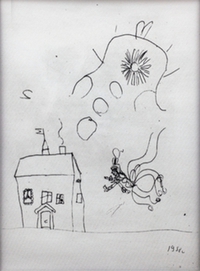 Alexandra Sukhareva Untitled (Etching according to the drawing of 1988), 2019
Osnova Gallery
€1,400
 Alexandra Sukhareva