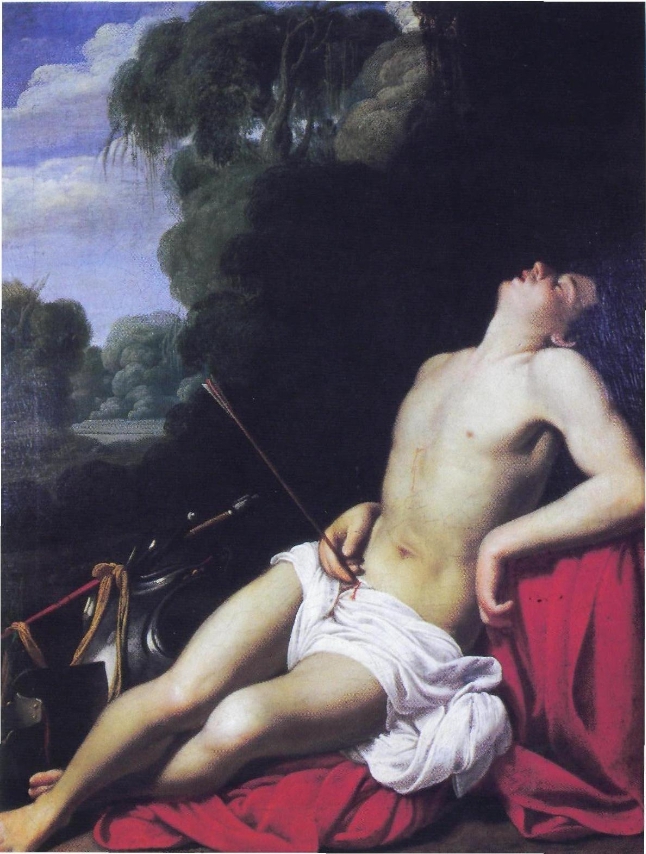
Carlo Saraceni, Public Domain
Homoeroticism
Homoeroticism is sexual attraction between members of the same sex, either male–male or female–female. The concept differs from the concept of homosexuality: it refers specifically to the desire itself, which can be temporary, whereas "homosexuality" implies a more permanent state of identity or sexual orientation. It is a much older concept than the 19th-century idea of homosexuality, and is depicted or manifested throughout the history of the visual arts and literature. It can also be found in performative forms; from theatre to the theatricality of uniformed movements (e.g., the Wandervogel and Gemeinschaft der Eigenen). According to Oxford English Dictionary, it's "pertaining to or characterized by a tendency for erotic emotions to be centered on a person of the same sex; or pertaining to a homo-erotic person." This is a relatively recent dichotomy that has been studied in the earliest times of ancient poetry to modern drama by modern scholars. Thus, scholars have analyzed the historical context in many homoerotic representations such as classical mythology, Renaissance literature, paintings and vase-paintings of ancient Greece and Ancient Roman pottery.
Artworks
-
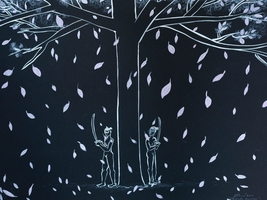 Rocío García El duelo samurái, 2019
El Apartamento
$3,000
Buy now
-
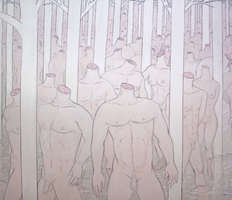 Rocío García Los elegidos, from the series Beliki tuman, 2019
El Apartamento
$18,000
Buy now
-
 Rocío García Viento, 2019
El Apartamento
$3,000
Buy now
 Rocío García