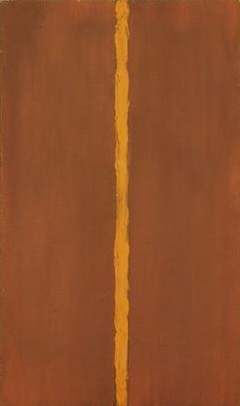
Barnett Newman, Onement 1, 1948. Fair Use
Abstract Expressionism
Abstract expressionism is a post–World War II art movement in American painting, developed in New York City in the 1940s. It was the first specifically American movement to achieve international influence and put New York at the center of the Western art world, a role formerly filled by Paris. Although the term "abstract expressionism" was first applied to American art in 1946 by the art critic Robert Coates, it had been first used in Germany in 1919 in the magazine Der Sturm, regarding German Expressionism. In the United States, Alfred Barr was the first to use this term in 1929 in relation to works by Wassily Kandinsky. Around 1944 Barnett Newman tried to explain America's newest art movement and included a list of "the men in the new movement." Paalen is mentioned twice; other artists mentioned are Gottlieb, Rothko, Pollock, Hofmann, Baziotes, Gorky and others. Robert Motherwell is mentioned with a question mark. Another important early manifestation of what came to be abstract expressionism is the work of American Northwest artist Mark Tobey, especially his "white writing" canvases, which, though generally not large in scale, anticipate the "all-over" look of Pollock's drip paintings. The movement's name is derived from the combination of the emotional intensity and self-denial of the German Expressionists with the anti-figurative aesthetic of the European abstract schools such as Futurism, the Bauhaus, and Synthetic Cubism. Additionally, it has an image of being rebellious, anarchic, highly idiosyncratic and, some feel, nihilistic.
Artworks
-
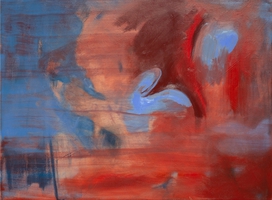 Julia Dubsky Fig Rabbit Duck (Kaninchen und Ente), 2020
Amanda Wilkinson Gallery
£4,000
Buy now
-
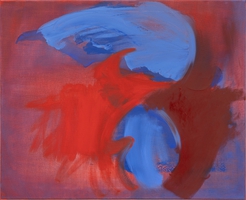 Julia Dubsky Fingers, 2020
Amanda Wilkinson Gallery
£3,500
Buy now
 Julia Dubsky