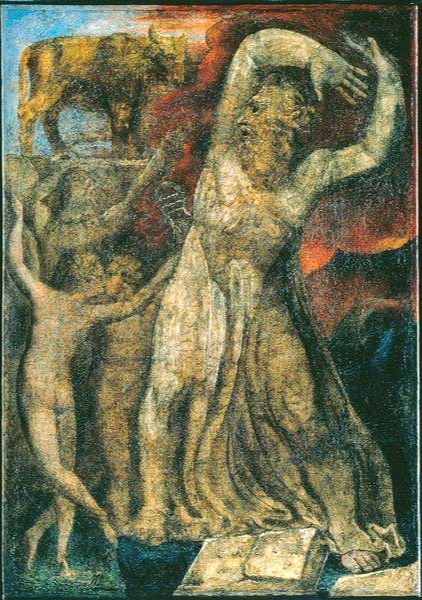
William Blake, Public Domain
Idols
Idolatry is the worship of an idol as though it were God. In Abrahamic religions (namely Judaism, Samaritanism, Christianity, the Baháʼí Faith, and Islam) idolatry connotes the worship of something or someone other than the Abrahamic god as if it were God. n these monotheistic religions, idolatry has been considered as the "worship of false gods" and is forbidden by the values such as the Ten Commandments. Other monotheistic religions may apply similar rules. In many Indian religions, such as theistic and non-theistic forms of Hinduism, Buddhism, and Jainism, idols (murti) are considered as symbolism for the absolute but not The Absolute, or icons of spiritual ideas, or the embodiment of the divine. It is a means to focus one's religious pursuits and worship (bhakti). In the traditional religions of ancient Egypt, Greece, Rome, Africa, Asia, the Americas and elsewhere, the reverence of cult images or statues has been a common practice since antiquity, and cult images have carried different meanings and significance in the history of religion. Moreover, the material depiction of a deity or more deities has always played an eminent role in all cultures of the world
 Anna Hulačová