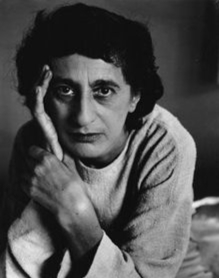
Anni Albers (born Annelise Elsa Frieda Fleischmann; June 12, 1899 – May 9, 1994) was an American textile artist and printmaker credited with blurring the lines between traditional craft and art. Anni Ablers was born Annelise Elsa Frieda Fleischmann on June 12, 1899 in Berlin, Germany. Fleischmann eventually decided to attend art school, even though the challenges for art students were often great and the living conditions harsh. Such a lifestyle sharply contrasted the affluent and comfortable living that she had been used to. She attended the Kunstgewerbeschule in Hamburg for only two months in 1919, then in April 1922 began her studies at the Bauhaus at Weimar.
At the Bauhaus she began her first year under Georg Muche and then Johannes Itten. Fleischmann struggled to find her particular workshop at the Bauhaus. Women were barred from certain disciplines taught at the school and during her second year, unable to gain admission to a glass workshop with future husband Josef Albers, Fleischmann deferred reluctantly to weaving, the only workshop available to women. She found that the weaving workshop was the only option open and to her dismay she gave it a try. Fleischmann had never tried weaving and believed it to be too "sissy" of a craft. With her instructor Gunta Stölzl, however, Fleischmann soon learned to appreciate the challenges of tactile construction and began producing geometric designs.[11] In her writing, titled Material as Metaphor, Albers mentions her Bauhaus beginnings: "In my case it was threads that caught me, really against my will. To work with threads seemed sissy to me. I wanted something to be conquered. But circumstances held me to threads and they won me over."
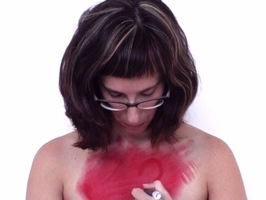 Nelly Agassi Burnt, 2000
Dvir Gallery
€5,675
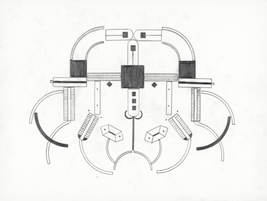 Nelly Agassi Drawing No. 2, 2014
Dvir Gallery
€5,675
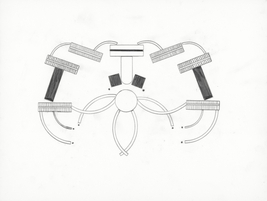 Nelly Agassi Drawing No. 3, 2014
Dvir Gallery
€5,675
 Nelly Agassi Sand it Better, 2002
Dvir Gallery
€5,675
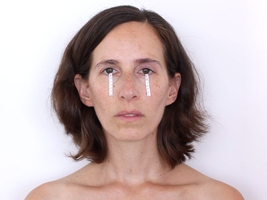 Nelly Agassi